
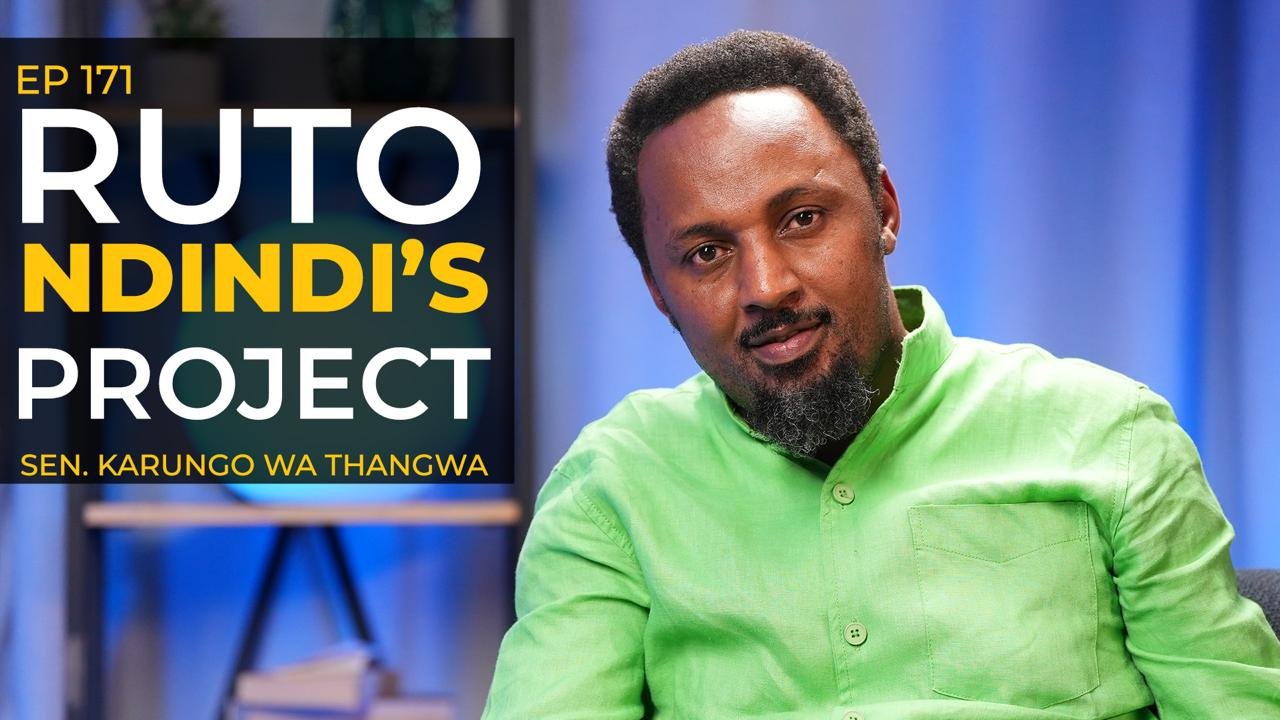

As Kenya moves closer to the 2027 General Election, the battle for political control of the Mt Kenya region is becoming one of the country’s most closely watched contests.
In a wide-ranging interview on Mambo Africa, Kiambu Senator Karungo wa Thang’wa strongly criticized President William Ruto’s administration, backed former Deputy President Rigathi Gachagua as a possible presidential candidate and questioned the political intentions of Ndindi Nyoro.
Karungo argued that many Kenyans who supported Ruto in 2022 expected a government that would improve their lives, but he believes the administration has failed to deliver on those expectations.
For him, Kenya now needs a change of leadership.
Karungo: Kenya Needs a New Political Direction
Karungo’s criticism of the current administration is direct.
He argues that the problems facing the country cannot be resolved without changing the leadership at the top.
According to him, citizens are struggling with economic pressure, political intolerance and frustration with institutions that are not always delivering the accountability Kenyans expect.
Karungo believes the 2027 election therefore represents an opportunity for voters to reassess the direction of the country.
His position is that President Ruto should serve only one term and that the opposition must unite behind a candidate capable of defeating him at the ballot.
Why Karungo Backs Rigathi Gachagua
Asked who he would support as Kenya’s next President, Karungo identifies Rigathi Gachagua as his preferred candidate.
He argues that Gachagua has experience in government and understands the concerns affecting different sectors of Kenyan society.
Karungo specifically points to agriculture, healthcare and education as areas where he believes a future government must provide more practical solutions.
He also portrays Gachagua as a politician who listens closely to citizens and understands the frustrations that have developed under the current administration.
However, Karungo also stresses that opposition unity must come before individual political ambitions.
If the wider opposition eventually agrees on another candidate, he argues that leaders must be prepared to support a common ticket rather than fragment the anti-Ruto vote.
The Battle for Mt Kenya
Mt Kenya remains central to the emerging 2027 political contest.
The region played a major role in President Ruto’s 2022 victory, but shifting alliances and the fallout between Ruto and Gachagua have created a new political landscape.
Karungo believes that voters in the region are increasingly evaluating leaders based on performance rather than simply political loyalty.
He points to recent political contests as evidence that money and government influence do not automatically guarantee electoral victory.
For him, this changes the calculations ahead of 2027.
The political battle is no longer simply about who can spend the most money or control the strongest political machinery.
It is increasingly about who voters believe genuinely represents their interests.
Karungo Questions Ndindi Nyoro’s Political Role
One of the most controversial parts of the interview comes when the discussion turns to Ndindi Nyoro.
Karungo questions whether Nyoro’s political repositioning should be trusted.
He alleges that Nyoro could ultimately help President Ruto by creating another centre of political influence in Mt Kenya and dividing votes that might otherwise consolidate behind the opposition.
Karungo describes this as a possible political strategy designed to weaken Gachagua’s influence.
These are Karungo Thang’wa’s political allegations and interpretation, not an established fact.
His argument nevertheless reflects the growing uncertainty over who will eventually command Mt Kenya’s political support in 2027.
Why Karungo Says Voters Should Look Beyond Political Money
The Senator also challenges Kenyans to rethink how they approach elections.
He argues that political handouts should not determine how citizens vote.
Karungo says voters can receive money from politicians and still make independent decisions at the ballot box based on their own interests.
His larger message is that political money should not be confused with leadership.
For Kenya to improve, he argues, citizens must elect leaders based on integrity, competence and genuine commitment to public service.
“You Cannot Legislate Morals”
The conversation also explores the role of the Senate and the difficulties senators face when overseeing county governments.
Karungo explains that senators are responsible for scrutinizing how county funds are used, but he argues that weaknesses in legal and institutional processes can make accountability difficult.
Audit reports may arrive late, investigations can take time and senators do not directly control the enforcement institutions that act on findings.
This leads Karungo to a broader argument about leadership.
According to him, laws alone cannot prevent corruption if voters repeatedly elect people who lack integrity.
His message is simple:
You cannot legislate morals.
For Karungo, citizens therefore carry a responsibility to choose leaders who genuinely want to serve rather than enrich themselves.
Senate Oversight and County Governments
Karungo also discusses the billions of shillings transferred to county governments every year.
He argues that devolution remains essential to Kenya’s development, but says county governments must be subjected to much stronger public scrutiny.
The Senate plays an important role in protecting counties and examining how public resources are used.
However, Karungo believes the current system still contains gaps that can make it difficult to respond quickly when funds are mismanaged.
He therefore calls for both institutional reform and better political choices by voters.
Political Goons and Violence Ahead of 2027
Another major concern raised during the interview is the use of political goons.
Karungo warns that organised political violence could become increasingly dangerous as Kenya approaches another election cycle.
He argues that political competition should be based on ideas and policies rather than intimidation.
Young people, in particular, should not be exploited by politicians for violent political mobilisation.
Karungo calls on state institutions to protect the democratic rights of citizens and ensure that political rallies and campaigns can take place without intimidation.
Lessons From the Ol Kalou By-Election
Karungo also reflects on the Ol Kalou by-election and what he believes the contest revealed about Kenya’s political future.
For him, one of the biggest lessons is that voters cannot automatically be bought.
He argues that politicians may distribute money, but citizens can still decide independently how they vote.
He also believes the contest demonstrated that powerful political machinery does not always guarantee victory.
Another lesson, according to Karungo, is the importance of protecting the vote after polling.
Citizens must remain engaged throughout the electoral process and ensure that the results reflect their choice.
IEBC and the Integrity of Elections
The Independent Electoral and Boundaries Commission also features in Karungo’s argument.
He says credible elections will depend on strong institutions, transparent processes and citizens who remain vigilant.
The 2027 election, he argues, will require Kenyans not only to vote but also to defend the integrity of the democratic process.
For Karungo, this is particularly important in an environment where political competition is becoming increasingly intense.
Can the Opposition Unite Before 2027?
Despite his support for Gachagua, Karungo acknowledges that defeating an incumbent President will require a broader coalition.
The opposition contains several leaders with their own ambitions, meaning negotiations over a common candidate could become one of the defining political stories of the next election.
Karungo’s argument is that unity must be driven by a common objective rather than personal ambition.
If the opposition enters 2027 fragmented, he believes President Ruto will benefit.
That is why the debate over Gachagua, Ndindi Nyoro and other opposition figures matters far beyond Mt Kenya.
It could ultimately shape the entire presidential race.
Character Could Matter More Than Political Machinery
Karungo’s broader message throughout the interview is that Kenya’s political future depends not only on institutions but also on the character of the people elected to lead them.
He challenges voters to examine whether candidates have integrity, whether they understand public service and whether they genuinely intend to improve the lives of citizens.
For him, leadership is not simply about winning power.
It is about what happens after power is won.
As the 2027 election approaches, the central question may therefore be less about which politician commands the strongest machinery and more about which candidate voters believe can be trusted with the future of the country.
The 2027 Question
Karungo wa Thang’wa has made his preference clear.
He believes Rigathi Gachagua can offer Kenya a new political direction.
He also believes President Ruto should be replaced and remains deeply suspicious of Ndindi Nyoro’s role in the emerging Mt Kenya political realignment.
But ultimately, Karungo says the decision belongs to Kenyan voters.
The next election will test whether citizens continue to follow traditional political alliances or increasingly vote based on performance, integrity and their own economic interests.
That question could determine not only who controls Mt Kenya, but who becomes Kenya’s next President.
Watch the Full Interview
🎥 Watch the full conversation with Senator Karungo wa Thang’wa:
🇰🇪 Who do you trust most to represent Kenya in 2027 — Rigathi Gachagua, Ndindi Nyoro, William Ruto, or another candidate?
Share your opinion and join the conversation.
Mambo Africa | THEE ALFA HOUSE

Leave a Reply