
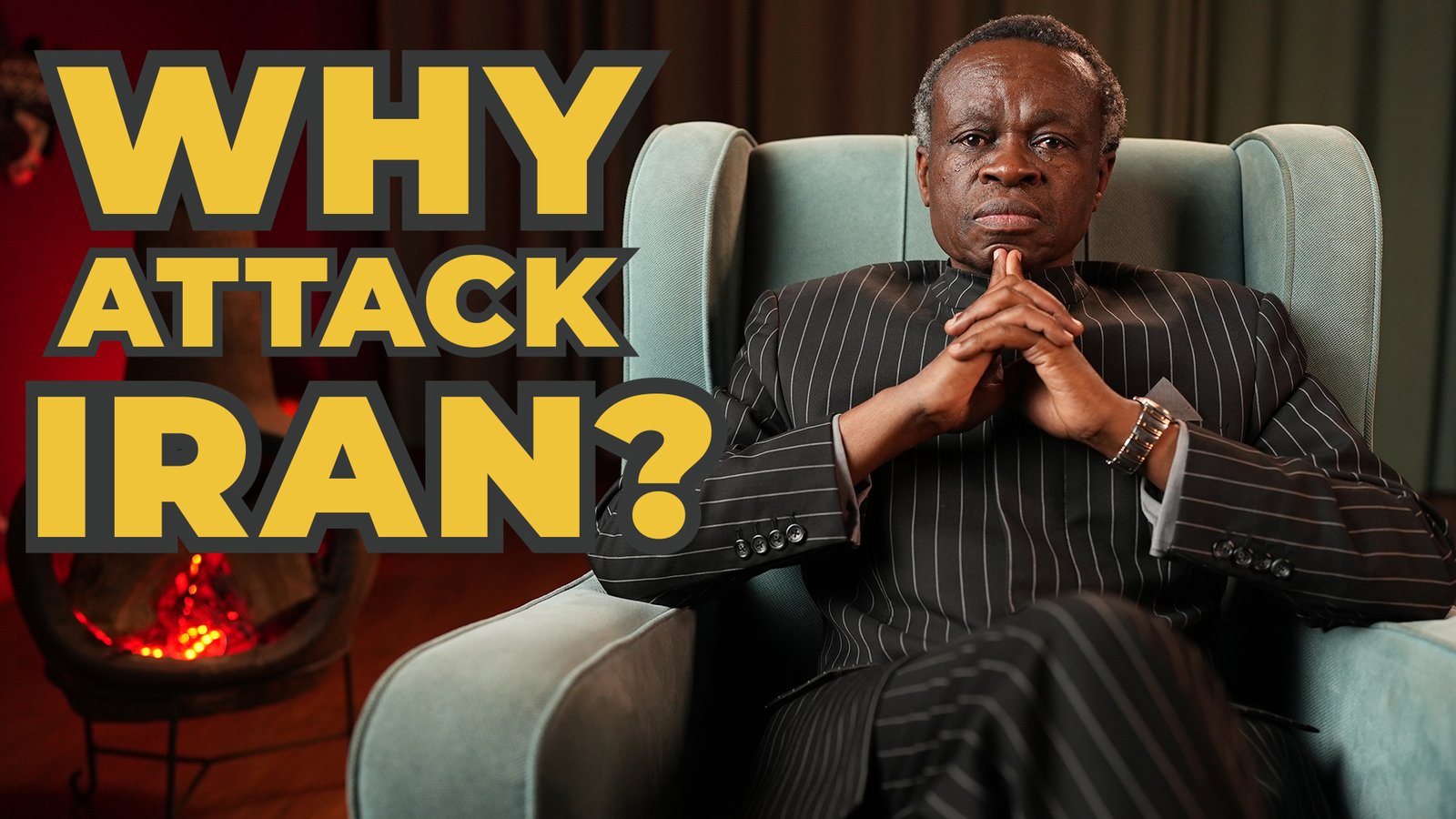

Prof. PLO Lumumba argues that the United States and Israel badly underestimated Iran — and that Tehran has discovered a weapon more disruptive than missiles: the Strait of Hormuz. At the same time, he warns that Russia and Ukraine remain trapped in a war where both governments speak about peace but disagree fundamentally on what peace should look like.
🎥 Watch the full episode:
https://youtu.be/a5_j0t1wJUc
In this new episode of PLO Lumumba Explain, Professor PLO Lumumba examines two of the world’s most dangerous conflicts through one central question:
Why do governments continue talking about peace while simultaneously increasing military pressure?
From the US–Israel confrontation with Iran to the continuing Russia–Ukraine war, Lumumba argues that modern diplomacy has become inseparable from military leverage, sanctions, control of trade routes and competition for global power.
Why Was Iran Attacked?
Lumumba begins with a question he believes Washington itself struggles to answer clearly:
Why is America at war with Iran?
In his analysis, Israel expanded the confrontation by linking Iran to Hamas, Hezbollah and the Houthis and then presenting strikes against Iran as part of a wider doctrine of pre-emptive defense. Lumumba challenges that interpretation and argues that the use of force should instead have been subjected to the mechanisms of the United Nations.
His argument is not simply about who fired first. It is about the wider international system.
If military force can be used outside collective international mechanisms whenever a powerful nation declares a security threat, Lumumba asks what remains of international law.
That question becomes even more important when wars begin producing consequences far beyond the countries actually fighting.
US and Israel Underestimated Iran
A major theme of the episode is what Lumumba describes as a serious strategic miscalculation.
According to him, the United States and Israel underestimated both the quantity and sophistication of Iran’s ballistic missiles and drones, as well as Tehran’s capacity to continue operating after military strikes.
He also points to Iran’s relationships with actors in Yemen, Lebanon, Iraq and Syria as part of a much wider regional network. Most importantly, he argues that Iran has been preparing for confrontation with Israel or the United States for decades and that expectations of a rapid internal collapse did not materialize.
For Lumumba, this helps explain why a confrontation expected to produce quick results instead became more difficult and expensive.
The lesson is familiar from history: military superiority does not always translate into political victory.
Iran’s Biggest Weapon May Not Be a Missile
Perhaps the most striking part of Lumumba’s analysis concerns the Strait of Hormuz.
He argues that Iran has discovered that geography can be more powerful than firepower.
The Strait of Hormuz is a vital corridor for global energy and commercial traffic. When movement through the strait is threatened or interrupted, the consequences extend immediately to shipping, insurance, oil, gas and consumer prices around the world. Lumumba says this pressure has forced the conflict away from the battlefield and into the global economy.
His conclusion is provocative:
“The Strait of Hormuz… that is the biggest weapon in the Iranian arsenal.”
Lumumba argues that what ballistic missiles could not achieve, pressure on the Strait of Hormuz may accomplish by creating an unavoidable need for negotiation.
When Hormuz Is Disrupted, Everyone Pays
The consequences are not confined to Washington, Tehran or Tel Aviv.
Lumumba connects disruption around Hormuz and Bab el-Mandeb with rising costs for cargo and insurance. Those costs eventually reach ordinary consumers, even thousands of kilometres away from the Middle East.
This is why the Iran conflict cannot be understood only as a regional war.
Energy powers manufacturing.
Energy powers transport.
Energy affects agriculture.
And transportation costs are built into almost everything consumers purchase.
A military confrontation around one of the world’s most important maritime corridors can therefore become an economic confrontation with the entire world.
Oil, the Dollar and American Power
Lumumba then takes the argument deeper.
The Middle East is not only strategically important because it contains oil. Oil has historically been deeply connected to the international role of the US dollar.
Lumumba connects the development of the petrodollar system with America’s wider financial power, arguing that Washington’s influence comes not only from aircraft carriers and military bases but also from the centrality of the dollar to international commerce.
That creates a much bigger geopolitical question.
As BRICS countries discuss alternative payment systems and a more multipolar economic order, are modern conflicts partly about protecting an international financial architecture built around Western power?
For Lumumba, oil, sanctions, currencies and military power increasingly belong to the same conversation.
Is America Becoming Trapped in an Unpopular War?
Lumumba also focuses on American domestic politics.
He argues that the war has become difficult to explain to ordinary Americans and that some voices inside the United States increasingly question why the country became involved.
In the transcript, Lumumba describes American policy toward Iran as inconsistent and says Washington bypassed the United Nations while entering a conflict whose purpose is becoming harder to articulate.
For him, this creates a political problem as well as a military one.
A government can sustain a foreign conflict more easily when citizens believe the objective is clear.
But when the public begins asking “Why are we fighting?”, the cost of war changes.
It becomes not only a geopolitical burden but a domestic political liability.
Russia and Ukraine: Everyone Wants Peace, But Whose Peace?
The second major part of the episode turns to Russia and Ukraine.
Here, Lumumba rejects simple answers.
He describes the conflict as extraordinarily difficult because Russia and Ukraine appear to have incompatible minimum requirements.
From Moscow’s perspective, Lumumba speculates that demands could include limitations on Ukraine’s NATO alignment and military capacity. From Kyiv’s perspective, sovereignty, Crimea and the right to determine Ukraine’s own alliances remain central issues. He stresses that these are not easy questions to reconcile.
That is why a simple call to “make peace” is not enough.
The real question is:
What compromises are both governments actually willing to accept?
Why Fighting Intensifies Before Negotiations
Lumumba makes another important observation about peace talks.
Military escalation immediately before negotiations can be deliberate.
The reason is leverage.
A combatant that controls more territory or demonstrates greater military capacity enters negotiations from a stronger position. Lumumba therefore interprets some escalations not necessarily as proof that peace has been abandoned, but as an attempt to improve bargaining power before negotiations begin.
This reveals the contradiction at the heart of the episode:
Countries can genuinely want negotiations while simultaneously trying to hurt their opponent before sitting at the negotiating table.
Peace and escalation can therefore occur at the same time.
War Fatigue Is Reaching Ordinary People
But governments are not the only actors that matter.
Lumumba says the effects of the Russia–Ukraine war are increasingly reaching households in both countries, creating a growing appetite for peace among ordinary people.
Beyond Russia and Ukraine, the economic costs are also international.
The conflict has disrupted energy, fertilizer, food production and global supply chains. Lumumba notes that Russia and Ukraine play important roles in commodities used around the world and argues that the economic case for ending the war is becoming increasingly difficult to ignore.
In other words, wars that begin as territorial or security disputes rarely stay contained.
Does Europe Really Want the Ukraine War to End?
Lumumba’s answer is complicated.
He argues that Europe does want peace — but Europe is divided about what peace should look like and how to achieve it.
Italy and Spain may speak differently from Britain. Germany carries its own historical sensitivities. France continues trying to project European leadership.
The result, in Lumumba’s view, is strategic confusion.
He believes the war is economically and politically heavy on Europe, yet European institutions also struggle to act as neutral mediators because several European countries are directly supporting Ukraine militarily.
This brings the discussion back to the institution Lumumba repeatedly says should matter most:
the United Nations.
Has the United Nations Become Too Weak?
Across both conflicts, Lumumba returns to the same institutional problem.
If individual states or military alliances decide when force is justified, who remains capable of acting as a neutral arbiter?
His answer is that the United Nations should play that role — but the institution itself increasingly requires reform.
The international structures created after World War II were designed for a very different global environment.
Today there is China.
There is a resurgent Russia.
There is India.
There is BRICS.
There are increasingly assertive powers across the Global South.
Yet the architecture of global security continues to reflect the power balance of 1945.
For Lumumba, that contradiction is becoming unsustainable.
Where Is Africa?
The final challenge concerns Africa.
African countries frequently suffer the consequences of global conflicts through higher fuel costs, fertilizer shortages, food inflation and disrupted trade.
But Africa remains far less influential in negotiating solutions.
Lumumba argues that Africa cannot expect to become a serious global mediator while remaining internally fragmented.
This echoes one of the wider principles that repeatedly appears throughout PLO Lumumba Explain: international influence begins with strength and organization at home.
Africa cannot merely react to decisions made in Washington, Moscow, Beijing, Brussels or the Middle East.
It must eventually develop the institutional and political strength to shape those decisions.
Peace in the Age of Permanent War
The central message of this episode is uncomfortable.
The world may talk constantly about peace, but peace negotiations do not happen outside power politics.
Iran uses geography.
America uses military and financial power.
Israel invokes security.
Russia seeks strategic guarantees.
Ukraine invokes sovereignty.
Europe calculates its security.
BRICS seeks alternatives to Western dominance.
And the United Nations struggles to remain relevant between them.
For Lumumba, the challenge is no longer simply ending one particular war.
It is building an international system in which diplomacy is stronger than escalation.
Until that happens, governments may continue promising peace while preparing for the next battle.
🎥 Watch the Full Episode
PLO Lumumba Explains Why Iran Was Attacked by US & Israel | Russia–Ukraine War, Which Way?
👉 https://youtu.be/a5_j0t1wJUc

Leave a Reply