
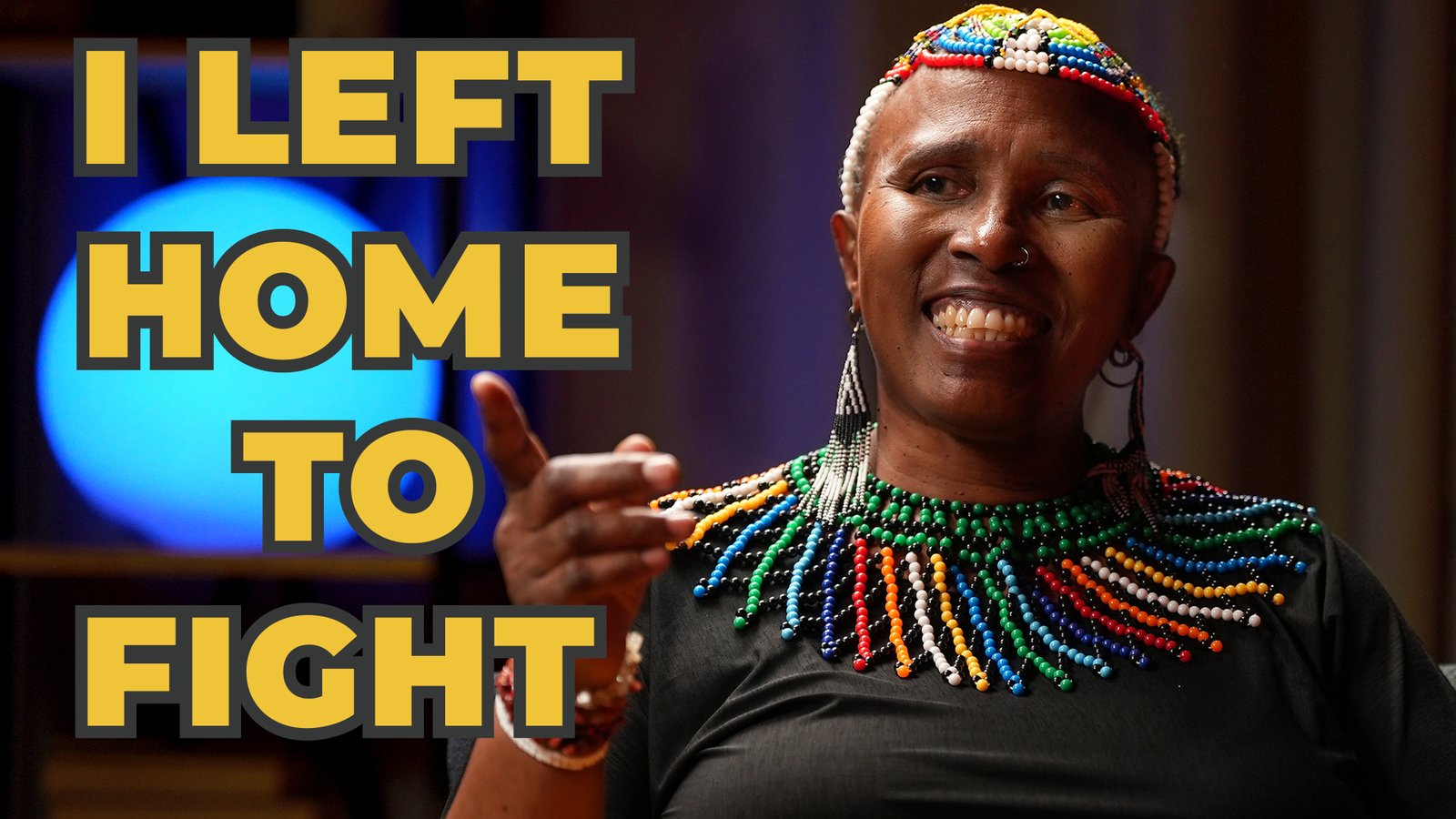

In an intimate conversation with her daughter, Dr. Khanyisile Litchfield-Tshabalala revisits her journey from apartheid-era Soweto to the uMkhonto we Sizwe military camps in Angola. She speaks about secretly reading Steve Biko, escaping South Africa as a teenager, becoming a combatant, losing comrades and questioning whether the country has honoured the generation that sacrificed its youth for freedom.
There is a moment in the conversation when history stops sounding like something preserved in books and becomes a mother’s memory.
Sitting opposite her daughter, Dr. Khanyisile Litchfield-Tshabalala recounts the decade of her youth that she dedicated to South Africa’s liberation struggle.
She does not begin with military training or political ideology. She begins with the experiences that convinced a young woman that ordinary life under apartheid had become impossible.
She remembers arrests, bullets, funerals, banned literature and the constant fear that security forces could arrive in the middle of the night.
Eventually, she reached a point where activism from inside South Africa no longer felt sufficient.
“I was really just so tired of ducking bullets. I think I wanted to be the one that fires these bullets.”
That decision would take her away from her mother, her education and her country—and into the military camps of uMkhonto we Sizwe, commonly known as MK, the armed wing of the African National Congress during the apartheid liberation struggle.
Growing Up Under the Apartheid System
Dr. Tshabalala describes the 1980s as one of the most volatile periods of apartheid.
Political repression was intensifying. Young activists were being detained, children were being arrested and expressing support for revolutionary movements could be treated as an offence against the state.
She remembers what activists called mass funerals—large communal burials held when hundreds of people had been killed in townships across South Africa.
In some cases, security forces would confront mourners even at the cemetery.
People could be tear-gassed or ordered to disperse before the coffins had been lowered into the ground.
For a young activist, these were not distant political events. They were part of everyday life.
Her political consciousness was also shaped by what she witnessed as a child.
She recalls seeing a Black man stabbed to death close to her family home. On another occasion, she saw a man chained to a pole by police because he did not have the pass documents demanded from Black South Africans under apartheid.
The two images remained with her: Black people being brutalised by the state, and Black people turning violence against one another.
At the time, she did not have the language to fully explain what she was witnessing.
That began to change when she discovered Steve Biko’s I Write What I Like.
Reading Steve Biko in Secret
Under apartheid, political literature associated with Black Consciousness, liberation movements or revolutionary thought could place its readers in danger.
Dr. Tshabalala remembers reading Biko’s work late at night and then hiding the book so carefully that it would not be found if security officers searched the house.
She could not even tell her family that she had it.
Reading the book felt like committing a crime.
But Biko’s writing gave her a framework for understanding the society around her. It helped her connect individual experiences of violence, humiliation and racism to the wider political system.
She began to understand that apartheid did not survive only through laws and armed force. It also operated psychologically, shaping how Black people saw themselves and one another.
Her political education did not come from one individual. It emerged from the totality of the environment: police brutality, township violence, struggle songs, student activism, banned books and the growing resistance movement.
Even small acts could carry political risk.
She recalls writing a school essay in which she imagined a football match between “Steve Biko High School” and “Mandela High School.” Her teacher quietly warned her that using those names could result in her being reported.
For Dr. Tshabalala, these incidents accumulated until remaining politically neutral was no longer possible.
From University Student to Political Activist
Dr. Tshabalala was expected to follow the educational path taken by most members of her family.
She enrolled at university and completed her first year successfully. But during her second year, political activism began to consume her life.
Instead of attending lectures, she spent months going to meetings and participating in the struggle against the apartheid political system.
She became involved with the Soweto Youth Congress and the wider structures of the United Democratic Front, which brought together youth organisations, workers, students, religious leaders and community formations opposed to apartheid.
Her mother believed that abandoning education for political struggle would lead to the same fate suffered by earlier activists who had been imprisoned, exiled or separated from their families.
But Dr. Tshabalala increasingly felt that others had already taken greater risks than she had.
At one political gathering, she heard a struggle song about young people who had left their parents and travelled to foreign lands to fight for freedom.
The song became what she describes as a kairos moment—the point at which she realised she could take her activism to another level.
By the end of the academic year, she also knew she would eventually have to explain why she had barely attended university despite her mother continuing to pay her fees.
Then an opportunity appeared.
A fellow activist told her that he had found a route out of South Africa.
She decided to go with him.
Secretly Crossing the Border
Leaving the country was known among activists as “skipping.”
It meant departing illegally and secretly, often without knowing when—or whether—you would return.
Dr. Tshabalala and her companion travelled by train from Johannesburg toward the border region.
She remembers looking closely at the advertisements and signs at the station, taking in ordinary details she had previously ignored.
She was suddenly aware that she might never see those places again.
A contact drove them close to the border at night. From there, they had to cross fences, avoid searchlights and move through the darkness without assistance.
Once they reached Botswana, they were instructed not to approach villagers unnecessarily because local communities had also been terrorised by apartheid South Africa’s cross-border operations.
Eventually, they reached a road where another contact collected them and took them to the appropriate offices.
The first step was not military training.
It was registering with the United Nations as a refugee.
While completing the process, Dr. Tshabalala noticed a message displayed on the wall:
“You never really appreciate freedom until you lose it.”
The words forced her to confront the seriousness of what she had done.
She had left her home, her legal identity and the life she understood. She had entered the unknown.
“Freedom Now, Education Later”
After being received by the ANC, young exiles were generally asked to choose between continuing their education or entering military training.
Those pursuing education could be sent to study in Tanzania or other countries that supported the liberation movements.
Those choosing the armed struggle would be sent toward the MK camps in Angola.
Dr. Tshabalala chose Angola.
Her generation embraced the slogan:
“Freedom now, education later.”
She had already left university behind. Returning immediately to a classroom felt inconsistent with the reason she had crossed the border.
Her journey continued through Botswana and Zambia before she was transported to Luanda, Angola.
At each stage, new arrivals were required to write detailed accounts of their lives. The liberation movement was concerned about infiltration, so recruits were questioned repeatedly to see whether their stories remained consistent.
From Luanda, Dr. Tshabalala was sent deep into Angola, where MK had established military camps in remote areas.
Angola itself was in the middle of a devastating civil war.
Entering the MK Camps in Angola
The camps were built in the bush, far from the ordinary infrastructure of towns and cities.
Recruits travelled for hundreds of kilometres by truck. They were warned about ambushes and told how to respond if the convoy came under attack.
Despite the danger, Dr. Tshabalala remembers the excitement of arriving.
She was young, politically committed and entering the world she had chosen.
Military training included firearms, artillery, topography, field medicine, physical preparation and political education.
Recruits needed to understand different weapons, navigate unfamiliar terrain and treat injuries in places where no doctor or hospital was available.
Training took place almost every day. Even Sundays were structured around formations, sport, poetry, cultural activities and traditional dance.
Life was disciplined and collective.
Some combatants slept in tents. Others lived in dugouts constructed partly below ground, which offered greater protection during possible bombing.
Dr. Tshabalala remembers that women were a small minority within MK. At certain points during her deployment, she was the only woman in her area.
Yet she says she did not feel sexually threatened by her male comrades.
Women were referred to as the “flowers of the revolution,” and she remembers a culture in which male combatants protected and respected the women serving alongside them.
That experience stands in painful contrast to what she now sees in South Africa.
One of her greatest disappointments with the country today is the scale of gender-based violence.
She questions how a liberation movement in which women could feel safe among overwhelmingly male combatants was followed by a society where so many women live in fear of men.
Firing an AK-47 for the First Time
One of Dr. Tshabalala’s most vivid memories is firing an AK-47 for the first time.
She broke down and cried.
It was not because she lacked the ability to use the weapon. She later discovered that she was an excellent marksman and received recognition for her shooting skills during further training.
She cried because the power of the weapon made her understand how vulnerable she had previously been.
As a young activist inside South Africa, she had confronted heavily armed forces while carrying little more than improvised protection.
The first shot made her realise how close she and her comrades had repeatedly come to death.
The experience transformed her understanding of the struggle.
It was no longer only about slogans, marches and political meetings. She was being prepared for armed combat against one of the continent’s most powerful military systems.
Socialism, African History and Political Education
Political education was central to life inside the MK camps.
The movement received extensive support from socialist countries, and its training reflected socialist and communist ideas.
Combatants also studied the history of African resistance to colonialism. For Dr. Tshabalala, this was one of the first times she encountered a structured history of how different African nations and communities had fought foreign conquest.
At the time, she embraced the socialist doctrine presented in the camps.
Years later, however, she began questioning whether international socialist ideology placed enough emphasis on African culture, Pan-Africanism and Afrocentric thought.
She wondered where African identity fitted into the vision of an international workers’ movement.
She also questioned why Africans should struggle only to become workers within an existing economic order rather than building systems in which Africans could also own enterprises, control production and become employers.
This later interrogation did not erase the contribution socialist countries had made to the liberation struggle.
She remains grateful for the support provided by the Soviet Union, Cuba and other countries that trained, equipped and protected Southern African liberation movements.
But her reflections reveal how the political ideas of a young combatant continued evolving long after the armed struggle ended.
Combat During Angola’s Civil War
MK combatants were in Angola to train for South Africa’s liberation, but Angola’s civil war made it impossible to remain untouched by the conflict around them.
The apartheid military supported UNITA, which was fighting Angola’s MPLA government.
MK camps and nearby communities were therefore vulnerable to attacks and ambushes.
Dr. Tshabalala was eventually deployed to the northern front, where she worked in propaganda and political communication.
Her duties included monitoring radio broadcasts, compiling news bulletins and presenting political analysis to the camp.
But being assigned to propaganda did not remove her from danger.
When emergency alarms sounded, combatants could be deployed rapidly to respond to attacks.
She says nobody is ever fully prepared for their first experience of combat.
The emotional impact depended partly on whether a fighter directly saw the people who had been shot. Firing at a distant position was different from witnessing a body at close range.
One particular loss would remain with her for the rest of her life.
The Comrade Who Said He Would Die
During her deployment, Dr. Tshabalala had a relationship with a fellow combatant.
MK members used combat names and were discouraged from revealing their real identities or home communities because the movement feared infiltration.
But he privately told her his real name and where he came from.
In the days before his death, he repeatedly woke Dr. Tshabalala and another female comrade during the early hours of the morning.
He wanted them to sit outside with him and look at the stars.
He told them he believed he was going to die in Angola.
They tried to stop him from speaking that way.
Then an emergency call came after a convoy was attacked.
Dr. Tshabalala was initially selected to join the rapid-response force. Her comrade argued that she should remain behind because of her propaganda responsibilities.
He took her place.
Before the trucks departed, he climbed down, ran back and said goodbye to her.
He never returned.
The responding force was itself caught in an ambush. He was shot in the chest and died at the scene.
When Dr. Tshabalala later reached the area, she immediately asked where he was.
The reaction of the officer told her the answer before anyone spoke.
Burying the Fallen in the Bush
The MK camps were far from conventional funeral services, hospitals and mortuaries.
When combatants died, their comrades prepared their bodies, built coffins from available wood and buried them themselves.
The bodies had to be guarded to prevent wild animals from reaching them.
Dr. Tshabalala personally washed and dressed the body of the man she had loved. She remained beside him until he was buried.
For decades, she did not know how to find his family.
Only many years later, after joining the modern political organisation using the MK name, did she ask comrades to help trace them.
The family told her that nobody had ever properly explained how he died or where he had been buried.
They had imagined many possible endings, including that he might have disappeared in the bush without a grave.
They wanted his remains returned home.
The encounter left Dr. Tshabalala carrying deep regret. She wished she had found them earlier, when his parents might still have been alive.
The family reassured her that his parents had died before the end of apartheid, meaning she would not have reached them even if she had started searching immediately after returning.
Still, the experience raised a painful question:
Why had the liberation movement and the post-apartheid government not made locating fallen combatants and informing their families a national priority?
The Unfinished History of MK
The interview does not romanticise the liberation struggle.
It honours those who fought while also asking difficult questions about accountability.
Dr. Tshabalala questions what happened to the extensive weaponry held by liberation movements across Southern Africa.
Rifles, pistols, grenades, artillery and anti-tank weapons do not simply disappear.
She argues that South Africa has never received a complete public accounting of those armouries.
She also questions whether proper records were kept of all combatants who died and were buried outside South Africa.
Her daughter argues that the country must confront this unfinished history.
Families deserve to know what happened to their children.
Those who died abroad deserve to be identified.
Where families wish to return remains home, governments should facilitate conversations with the countries where liberation fighters were buried.
Political freedom did not erase those obligations.
From Liberation Movement to Political Party
Dr. Tshabalala also explains why her journey with the ANC ended when it changed from a liberation movement into a governing political party.
During South Africa’s transition, she became concerned about decisions made regarding the integration and transformation of the country’s armed forces.
She saw institutions and practices associated with the liberation movement being replaced by Western military traditions and equipment.
For her, this represented more than a technical change.
It symbolised the direction in which the post-apartheid state was moving.
The movement that had trained her through socialist and anti-colonial partnerships was entering a political and economic order that she believed had not been fundamentally transformed.
She chose not to continue with the ANC as a political party.
Her criticism reflects one of the central tensions explored throughout the interview:
What happens when a liberation movement wins political power but does not complete the economic and social transformation for which its members sacrificed?
“Do Not Wish Civil War on Your Country”
Having witnessed Angola’s civil war, Dr. Tshabalala gives an emphatic warning to Africans who speak casually about violent national collapse.
“Don’t wish civil war on your country. Nobody wins in civil war.”
Civil wars destroy infrastructure, divide communities and leave wounds that can take generations to repair.
For African countries already struggling with limited resources and the unresolved consequences of colonialism, recovery can be especially difficult.
Her experience in Angola taught her that political frustration must never make people underestimate the destruction of internal war.
Revolution, resistance and political change may be necessary, but the collapse of a country is not liberation.
Zambia, Angola and the Nations That Supported Liberation
Dr. Tshabalala describes Zambia as the mother of liberation in Southern Africa.
Under President Kenneth Kaunda, Zambia hosted liberation movements from South Africa, Zimbabwe, Namibia and other countries despite the danger of cross-border attacks.
Angola allowed military camps to operate on its territory while fighting its own civil war.
Cuba sent forces that helped prevent apartheid South Africa from advancing further into Angola.
The Soviet Union and other socialist states provided military equipment, political education and specialist training.
She contrasts those sacrifices with modern arguments about migration and entitlement.
The countries that supported Southern Africa’s liberation did not later claim permanent ownership over South Africa or demand the right to disregard its laws.
Their assistance was presented as solidarity rather than a transactional debt.
For Dr. Tshabalala, that distinction matters when defining genuine Pan-Africanism.
A Daughter Questions What Freedom Became
The presence of Dr. Tshabalala’s daughter makes this interview especially powerful.
This is not merely a public figure retelling her political history.
It is a daughter asking what her mother surrendered before she became a mother.
She asks about the fear, training, relationships, ideology and loss that shaped an entire decade of Dr. Tshabalala’s life.
She also asks what the younger generation should learn from that sacrifice.
Near the end of the conversation, she argues that citizens must not allow dominant political parties to use liberation history as permanent protection from accountability.
No organisation fought apartheid alone.
And having participated in liberation does not excuse a government that later becomes an obstacle to progress.
A country honours its freedom fighters not simply by celebrating them, but by building the society for which they fought.
Why One African Country’s Crisis Affects Its Neighbours
Dr. Tshabalala closes by widening the discussion beyond South Africa.
The dysfunction of one country, she argues, inevitably affects the countries around it.
Conflict, economic collapse, criminal networks and unregulated movement do not remain within national borders.
She points to East Africa’s experiences with regional instability and praises attempts to develop stronger regional legislative institutions.
For her, African integration cannot be based only on slogans.
Regional organisations must be capable of creating and enforcing common rules. Pan-Africanism must protect citizens, regulate movement, confront illicit financial flows and strengthen the continent’s collective institutions.
Without functioning countries and effective regional bodies, the African Union itself cannot become strong.
A Story That Must Be Preserved
Dr. Tshabalala’s testimony reminds viewers that the people who fought apartheid were not born as historical figures.
They were students, sons, daughters, friends and young lovers.
They made decisions without knowing whether they would survive long enough to see the results.
They left classrooms for military camps.
They exchanged their legal names for combat names.
They buried one another in foreign soil.
And many returned to countries that still struggle to recognise the full cost of their sacrifice.
This mother-and-daughter conversation preserves a part of that history through lived memory.
It asks South Africa to remember those who fought, locate those who never returned and confront the difference between achieving political freedom and completing liberation.
Most importantly, it gives a younger generation an opportunity to hear the story directly from someone who lived it.
Watch the Full Conversation
Watch Dr. Khanyisile Litchfield-Tshabalala’s deeply personal conversation with her daughter about apartheid, exile, MK military training, combat and the unfinished struggle for freedom:
Please subscribe to our YouTube channel and share the interview.
Every subscription helps us document more important African stories, reach a wider audience and continue producing conversations that preserve the continent’s history for future generations.

Leave a Reply