
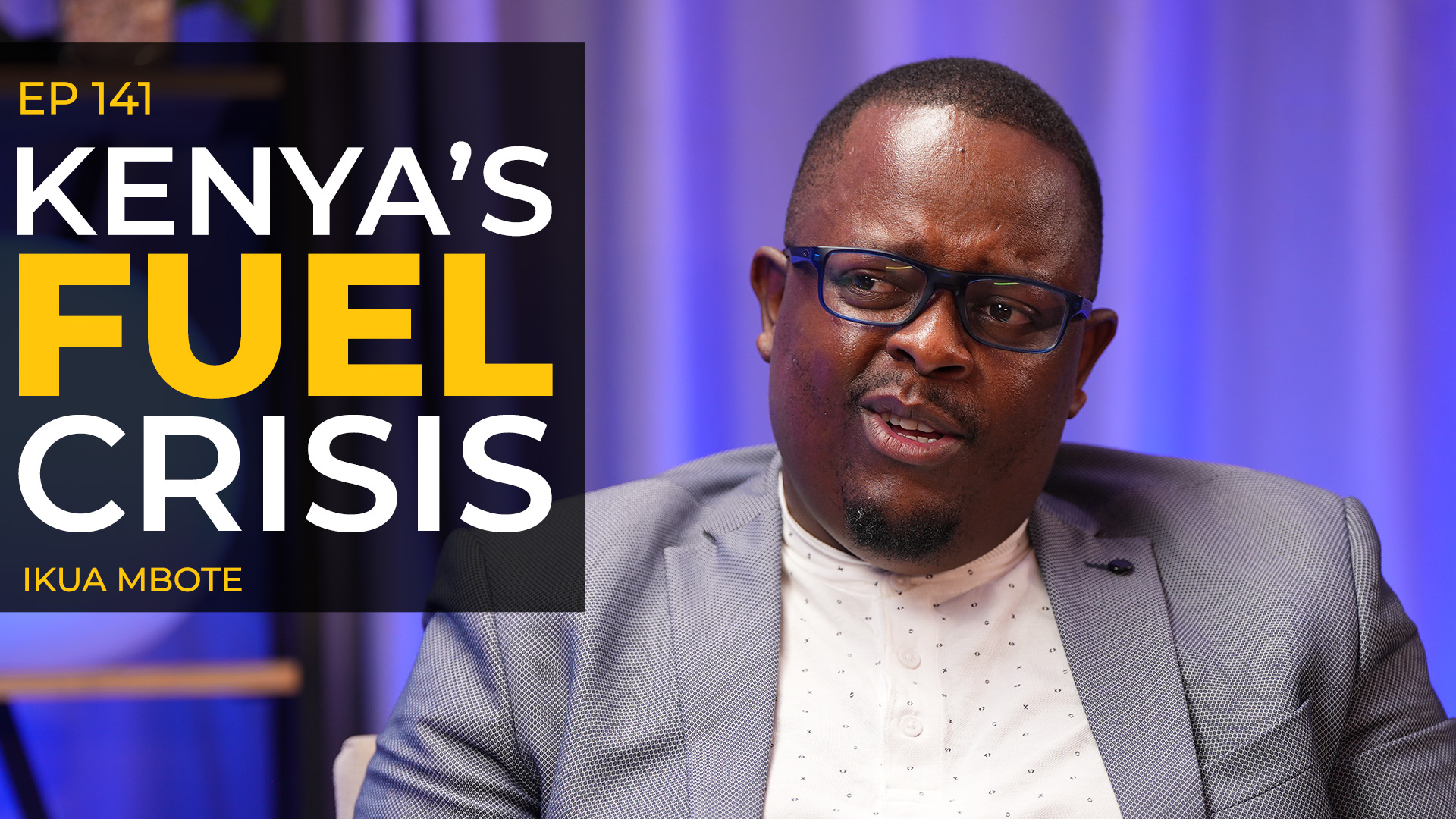

Why Kenyans Continue to Feel Pain at the Pump
Fuel prices remain one of the biggest economic and political issues in Kenya.
Every increase in fuel prices immediately affects transport costs, food prices, electricity, business operations and the overall cost of living. For millions of ordinary Kenyans, expensive fuel is not just an energy problem — it is a survival problem.
In a detailed conversation on Mambo Africa, political analyst and businessman Ikua Mbote broke down the politics behind Kenya’s fuel market, the controversial G-to-G oil agreement, fuel levies, taxes, pipeline charges and why many citizens feel trapped in an expensive fuel economy.
According to Ikua, Kenya’s fuel crisis is not simply about global oil prices.
He argues that the crisis is deeply connected to leadership, monopoly, poor policy decisions and the wider geopolitics of oil.
Watch the full episode here: https://youtu.be/AprdwVpV0SA
What Is the G-to-G Oil Agreement?
One of the main issues discussed in the interview was Kenya’s Government-to-Government (G-to-G) oil agreement.
Ikua explained that the arrangement changed how Kenya sources fuel by limiting open market competition and concentrating fuel supply under a smaller number of approved players.
According to him, before the G-to-G framework, oil marketers and suppliers had more room to source products through competitive international markets. The new arrangement, he argues, reduced competition and created conditions where a few connected businesses benefit while consumers absorb higher costs.
For Ikua, the biggest concern is not just the existence of the agreement, but the lack of transparency around its implementation and long-term consequences.
He questioned why ordinary citizens continue paying more at the pump while government insists the arrangement is stabilizing supply.
Why Uganda Sometimes Has Cheaper Fuel Than Kenya
A major talking point in the interview was the comparison between Kenya and Uganda.
Ikua questioned why Uganda can sometimes access cheaper fuel despite depending heavily on Kenyan infrastructure, including the Port of Mombasa and Kenya Pipeline systems.
He argued that this raises serious questions about pricing structures, levies and the efficiency of Kenya’s fuel management system.
For him, if neighboring countries can achieve lower fuel costs while relying on Kenya’s transport infrastructure, then Kenya must critically examine its taxation model, logistics system and policy framework.
The issue, according to Ikua, is not just international oil prices.
It is also about how Kenya structures its domestic fuel economy.
Fuel Levies, Taxes and the Cost of Living
Ikua also broke down the many charges attached to fuel prices in Kenya.
He pointed to:
- Road Maintenance Levy
- Excise Duty
- VAT
- Petroleum Development Levy
- Anti-adulteration charges
- Pipeline and storage costs
- Forex-related import costs
According to him, the cumulative effect of these charges places a heavy burden on consumers.
He explained that because fuel drives transport and production, high fuel prices eventually affect almost every sector of the economy.
When fuel becomes expensive:
- Food becomes more expensive
- Public transport fares rise
- Manufacturing costs increase
- Electricity prices can rise
- Businesses struggle to survive
- Disposable income shrinks
Ikua argued that government must find a balance between revenue collection and protecting citizens from unbearable economic pressure.
The Bigger Question: Is Fuel Policy Citizen-Oriented?
Throughout the conversation, Ikua repeatedly challenged government to become more citizen-oriented in energy policy.
He argued that economic systems should ultimately serve ordinary people rather than narrow political or business interests.
According to him, Kenya’s current fuel framework appears designed more around protecting powerful interests than ensuring affordability for consumers.
He warned that monopolistic tendencies in oil supply can distort markets, reduce healthy competition and create conditions where prices remain artificially high.
For Ikua, opening the market to more suppliers and encouraging genuine competition would likely benefit consumers.
He believes competition remains one of the strongest ways to drive efficiency and reduce unnecessary pricing pressure.
Africa’s Oil Problem Is Bigger Than Kenya
The discussion also widened beyond Kenya to Africa’s broader energy challenge.
Ikua argued that African countries continue to suffer because the continent lacks coordinated energy strategies.
Despite Africa having large oil and gas reserves, many countries still export raw materials while importing refined fuel products at higher costs.
According to him, Africa must stop functioning as fragmented individual markets and instead think collectively.
He proposed stronger regional cooperation around:
- Oil refining
- Energy infrastructure
- Pipeline development
- Fuel reserves
- Negotiating power in global markets
- Intra-African trade
For Ikua, a united African energy market would give the continent more bargaining power and reduce dependence on foreign-controlled systems.
Why Refineries Matter
A major point raised in the interview was the importance of refinery investment.
Ikua argued that Africa cannot continue exporting crude oil while importing expensive refined products.
He pointed to examples such as the Dangote Refinery in Nigeria as evidence that African countries can invest in large-scale refining capacity.
According to him, Kenya and East Africa should also think long term about:
- Building refinery infrastructure
- Supporting local value addition
- Investing in Turkana oil opportunities
- Expanding energy security
- Reducing reliance on imported refined products
He believes this is necessary if Africa wants to survive in a world increasingly shaped by geopolitical competition over energy resources.
Geopolitics, Oil and Global Power
The interview also connected Kenya’s fuel crisis to global geopolitics.
Ikua discussed how conflicts involving Russia, Iran, the Gulf region and Western powers affect oil prices worldwide.
He argued that Africa often suffers the consequences of global energy conflicts despite having limited influence over international pricing structures.
According to him, the world is moving into a more competitive geopolitical era where countries are fighting for control over:
- Energy supply chains
- Trade routes
- Currency systems
- Strategic minerals
- Global markets
He warned that Africa must prepare itself economically and strategically rather than remain dependent on external powers.
Leadership and Economic Understanding
A recurring theme in the interview was leadership.
Ikua repeatedly emphasized that economic management requires leaders who understand systems, markets, energy policy and governance.
He criticized performative politics and argued that many leaders fail to understand how interconnected fuel, taxation, transport and development really are.
According to him, countries cannot transform through slogans alone.
They require:
- Long-term planning
- Institutional thinking
- Economic discipline
- Strategic infrastructure investment
- Citizen-centered policies
He also challenged voters to elect leaders capable of understanding complex economic realities rather than simply responding to political emotions.
Kenya’s Economic Reality
Ikua linked the fuel crisis to the wider economic difficulties facing ordinary citizens.
He explained that when fuel becomes expensive, every household eventually feels the impact.
For him, the issue is not just what happens at the petrol station.
It is about whether:
- Businesses can survive
- Food remains affordable
- Young people can find jobs
- Public transport stays manageable
- Farmers can transport produce
- Citizens retain purchasing power
He argued that Kenya’s economy cannot become competitive if energy costs remain excessively high.
Why Africa Must Think Bigger
One of the strongest ideas from the conversation was the need for Africa to think collectively.
Ikua argued that the continent’s biggest weakness is fragmentation.
Instead of acting as one large economic bloc, African countries often negotiate separately and compete against each other.
He believes that if Africa united around energy and trade policy, it could:
- Negotiate better oil deals
- Build stronger infrastructure
- Protect consumers
- Expand industrialization
- Strengthen sovereignty
- Increase economic independence
For him, energy policy should not just be about profit.
It should be about building long-term continental strength.
Conclusion: Fuel Prices Reflect Bigger Governance Questions
The conversation with Ikua Mbote ultimately reveals that fuel prices are not only about oil.
They reflect bigger questions about:
- Governance
- Economic planning
- Taxation
- Infrastructure
- Competition
- Leadership
- Regional cooperation
- Africa’s place in global geopolitics
For ordinary Kenyans, expensive fuel affects daily life in immediate and painful ways.
But for Ikua, the deeper challenge is whether Kenya — and Africa more broadly — can build systems that prioritize citizens, support local investment, strengthen energy independence and create long-term economic stability.
His argument is simple:
Africa must stop reacting to global energy politics and start shaping its own future.
Watch the full episode here:
https://youtu.be/AprdwVpV0SA

Leave a Reply