
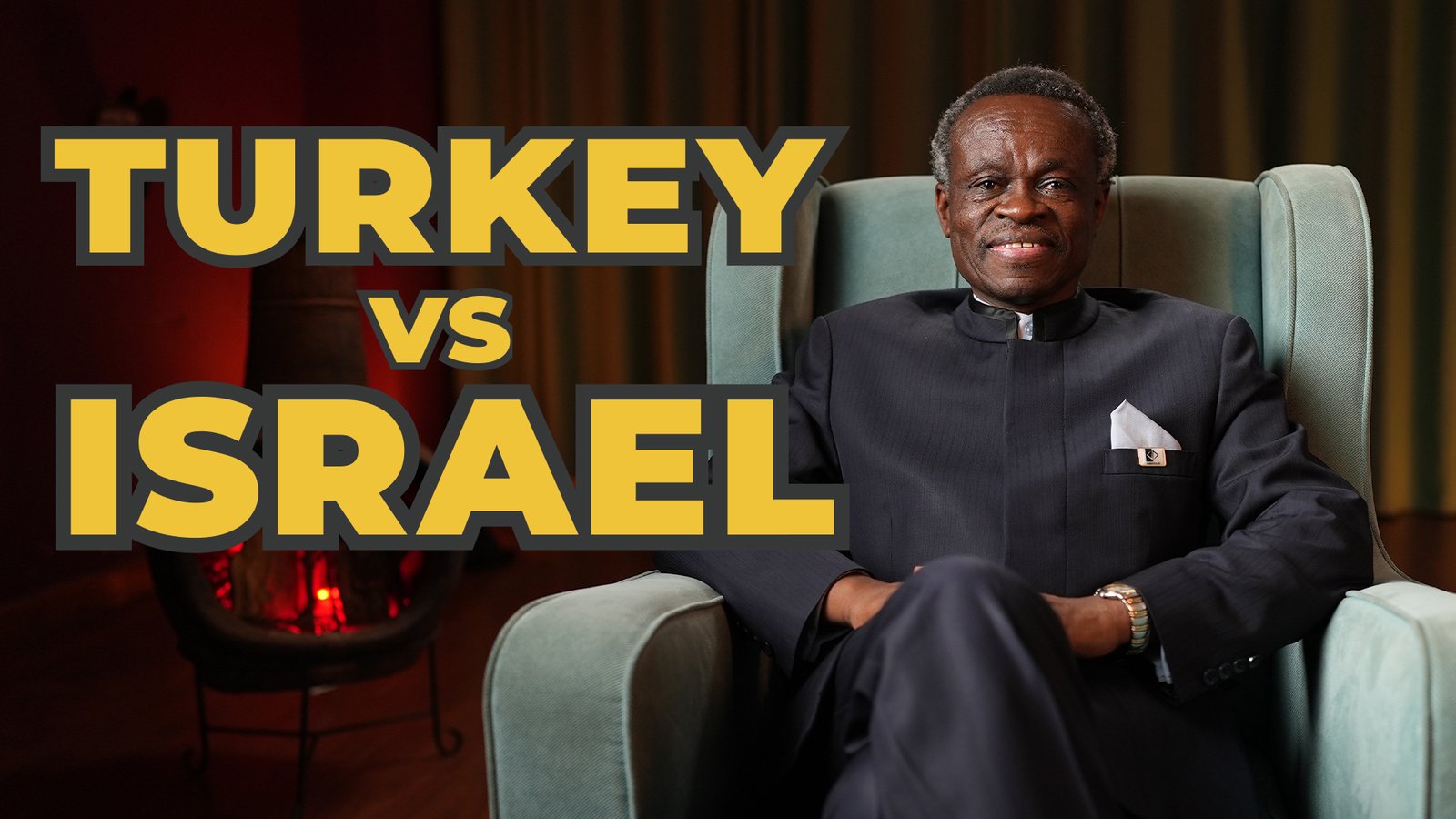

In this episode of PLO Lumumba Explain, Prof. PLO Lumumba analyzes the new defense understanding between Saudi Arabia, Turkey and Pakistan, described in the discussion as the Mecca Accord — a pact built around a familiar military principle:
Attack one, attack all.
For Lumumba, this agreement cannot be understood as a simple diplomatic statement. It must be read in the wider context of a changing world order, the weakening trust in NATO, the war in Gaza, Israel’s regional posture, Turkey’s frustrations with Europe, and Saudi Arabia’s search for stronger security guarantees.
The central question is clear:
Is this the beginning of a new Muslim defense bloc — or a warning that the old Western-led security order is no longer trusted?
Watch the full episode here:
https://youtu.be/NLNUnSyAjP0?si=Awp5BOKAHcSo-Zhs
The Mecca Accord and the “Attack One, Attack All” Principle
Lumumba begins by comparing the Saudi-Turkey-Pakistan pact to NATO’s most famous principle: an attack on one member is treated as an attack on all.
This idea was at the heart of NATO after the Second World War. The alliance was created in a bipolar world where the United States and its European allies saw the Soviet Union as the main military and ideological threat.
But Lumumba argues that today’s world is no longer the world of 1945, 1952 or the Cold War. The Soviet Union collapsed. Russia returned as a major power. China rose as an economic giant. Turkey became more assertive. Africa began resisting old colonial arrangements. BRICS started challenging Western financial dominance.
In that changing environment, a new defense pact between Saudi Arabia, Turkey and Pakistan becomes more than a regional headline. It becomes a symbol of a world in transition.
Why NATO Is Being Tested
A major part of Lumumba’s analysis is that NATO is no longer operating in the world for which it was created.
NATO was built to defend Western Europe against the Soviet Union. But today, the threats, alliances and global interests are far more complex. Europe is now questioning whether it can fully rely on the United States, especially after years of American pressure for NATO members to increase defense spending.
Lumumba argues that Donald Trump’s approach to NATO exposed a deeper anxiety inside Europe: if the United States can change its foreign policy depending on who occupies the White House, then Europe cannot simply assume that American protection is permanent.
This is why many European countries are increasing defense expenditure and rethinking their security strategies. NATO may not disappear, but it is being forced to adjust to a new reality.
Why Turkey Is Looking Beyond NATO
Turkey’s role in this new pact is one of the most important questions in the episode.
Turkey has been a NATO member since 1952. Yet, according to Lumumba, Turkey has never been fully accepted by Europe. Its long effort to join the European Union has remained blocked for decades, with European leaders repeatedly arguing that Turkey does not meet the required conditions for membership.
Lumumba suggests that Turkey may now be asking a difficult question:
If NATO countries trust Turkey militarily, why do they not trust Turkey economically and politically inside the European Union?
This contradiction may help explain why Turkey is looking for alternative partnerships with countries closer to its geography, religion and strategic interests.
For Lumumba, President Recep Tayyip Erdoğan sees Turkey as more than a NATO member. He sees Turkey as a regional power with historical memory, especially because of the Ottoman Empire’s former presence in the Middle East.
Gaza, Israel and the Division of the West
Lumumba connects the rise of new alliances to the war in Gaza and Israel’s wider role in the Middle East.
He argues that Israel’s actions in Gaza have exposed deep divisions within NATO and Europe. Some European countries have supported stronger accountability measures against Israeli leaders, while the United States has remained firmly protective of Israel.
This contradiction, Lumumba says, reveals the double standards of international law.
When warrants or legal actions are directed at leaders outside the Western alliance, they are treated as legitimate. But when legal action targets Israeli leaders, the same institutions are attacked, sanctioned or dismissed.
For Lumumba, this has damaged the credibility of global institutions such as the International Criminal Court and the United Nations.
Saudi Arabia’s Security Question
Saudi Arabia’s decision to join such an understanding also has a strategic explanation.
Lumumba argues that Saudi Arabia has been exposed by repeated instability in the region, including attacks connected to the Houthis in Yemen and the broader consequences of the Gaza war.
Saudi Arabia has long had a close relationship with the United States, especially around oil, security and regional influence. But Lumumba suggests that Riyadh may no longer be fully satisfied with American protection.
If Saudi Arabia feels that Washington cannot or will not respond strongly enough to threats in the region, then it makes sense for Saudi Arabia to explore new defense relationships.
The Mecca Accord, in this view, is not only about religion. It is also about survival, security and strategic independence.
Pakistan’s Strategic Role
Pakistan’s entry into the pact is also significant.
Lumumba links Pakistan’s role to the wider geopolitical alignment between India and Israel. As India moves closer to Israel diplomatically and strategically, Pakistan may see value in aligning more closely with Turkey and Saudi Arabia.
Pakistan is also a nuclear-armed state with a powerful military establishment. Its involvement gives the pact greater weight, even if the practical military consequences remain uncertain.
Lumumba does not suggest that Pakistan, Turkey and Saudi Arabia would automatically rush into war after every attack. Instead, he warns that real diplomacy is more complicated than written agreements.
Alliances may say “attack one, attack all,” but when actual war begins, every country calculates its own risks.
Would the Pact Really Be Triggered?
One of the most important points in Lumumba’s analysis is the difference between what is written on paper and what happens in real conflict.
Shortly after the pact was discussed, the Houthis reportedly attacked an installation inside Saudi Arabia. Commentators immediately asked whether this would become the first test of the alliance.
Would Turkey respond?
Would Pakistan respond?
Would Saudi Arabia demand collective action?
Lumumba says international diplomacy has many back channels. Even when agreements sound automatic, states still consider timing, cost, escalation, public opinion, military readiness and global consequences.
This is why he warns against simplistic interpretations. The Mecca Accord may be powerful symbolically, but real war would involve many calculations.
Netanyahu, Israel and Permanent War
Lumumba also gives strong attention to Benjamin Netanyahu’s leadership.
He argues that Netanyahu represents an expansionist and deeply militarized form of Israeli politics. According to Lumumba, Netanyahu’s survival is tied to war because war delays political accountability and keeps Israel’s security narrative at the center of national politics.
Lumumba describes Israel as a state increasingly dependent on conflict — a “war economy” that maintains international support by presenting itself as permanently under threat.
This, he warns, is dangerous because it creates incentives for continued escalation in Gaza, Lebanon, Syria, Yemen, Iran and possibly even against Turkey.
The Danger of a Wider Middle East War
For Lumumba, the Middle East is a powder keg.
A direct confrontation between Israel and Turkey would be extremely dangerous, especially if Saudi Arabia and Pakistan are tied to Turkey through a defense pact. Even if the alliance is not automatically triggered, the political pressure on those countries would be intense.
The risk is that a regional conflict could move beyond Gaza and Iran into a wider confrontation involving multiple states, religious identities, nuclear-capable powers and global military alliances.
Lumumba warns that once war begins, it cannot always be controlled by those who started it.
The Collapse of the Old Global Order
The larger theme of the episode is the weakening of institutions created after the Second World War.
Lumumba argues that NATO, the United Nations, the Bretton Woods institutions, the International Criminal Court and the broader Western-led international system are all being tested.
The United States still holds enormous military and economic power, but its moral authority is increasingly questioned. Europe is divided. Russia refuses to be isolated. China continues to rise. BRICS challenges Western financial dominance. Africa is beginning to reject old colonial patterns.
In this environment, new alliances are not accidental. They are signs of a world searching for a new balance.
Conclusion: A Warning to NATO, Israel and the West
The Mecca Accord may or may not become a fully operational military alliance. It may not function like NATO in a real war. But for Lumumba, its symbolic meaning is already powerful.
It tells the world that Saudi Arabia, Turkey and Pakistan are thinking beyond old security arrangements.
It tells NATO that its influence is no longer automatic.
It tells the United States that some of its allies are questioning its reliability.
It tells Israel that its regional actions may be creating new opposition.
And it tells the world that the old post-1945 order is being reconfigured in real time.
Whether this becomes a new Islamic NATO or remains a diplomatic warning, the message is clear:
The world is changing, and old alliances can no longer be taken for granted.

Leave a Reply