
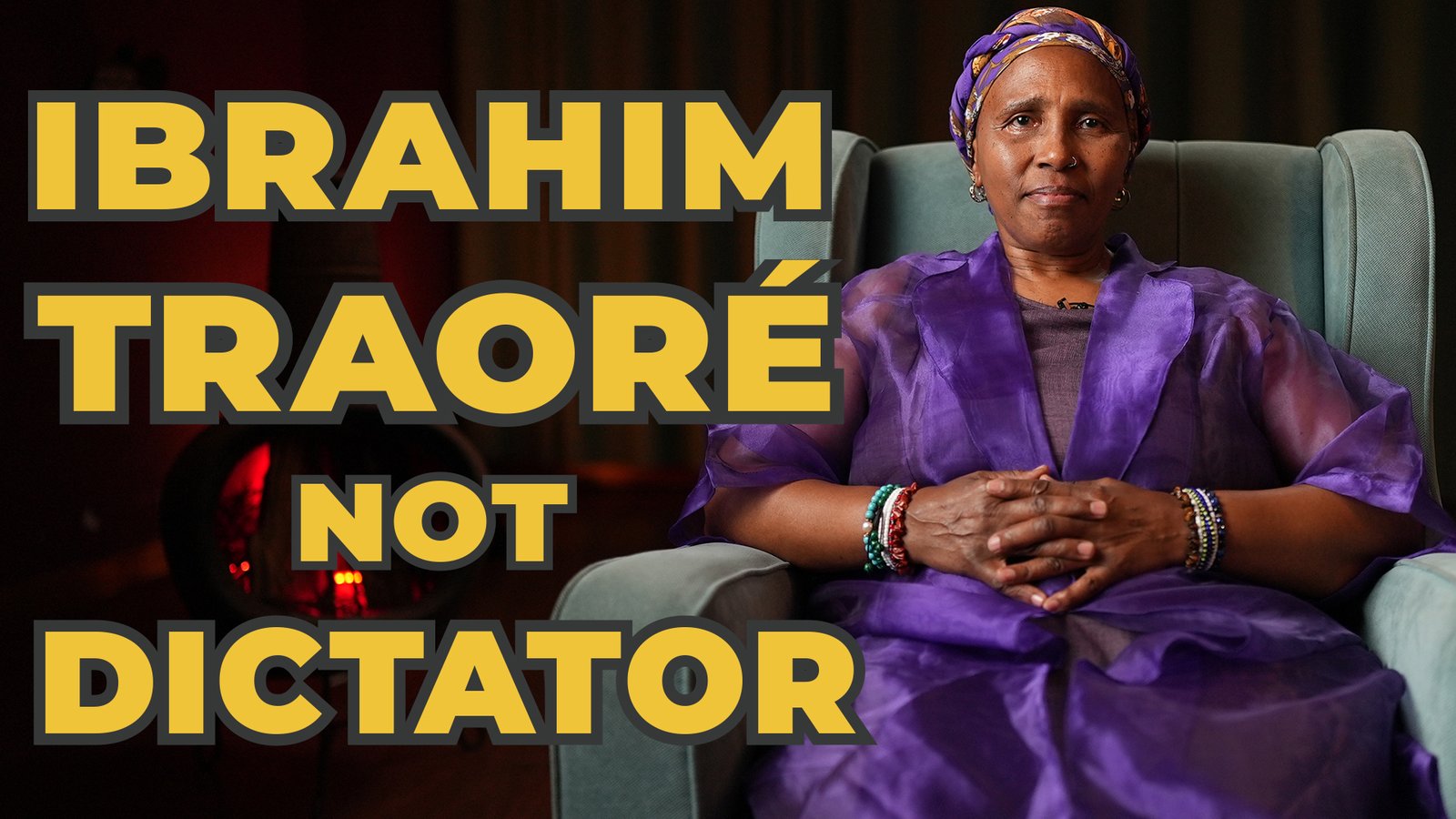

Dr. Khanyisile Litchfield-Tshabalala argues that Burkina Faso’s Ibrahim Traoré represents more than another military government. In a wide-ranging conversation, she challenges Africa to question Western-style democracy, confront neocolonialism and reclaim control over its economies, resources and security.
Is democracy really working for Africa?
For South African politician, Pan-African thinker and former Rear Admiral Dr. Khanyisile Litchfield-Tshabalala, the answer is uncomfortable but clear: not in the form in which it has been inherited and practised across much of the continent.
Speaking in a wide-ranging conversation on Africa’s political and economic future, Litchfield-Tshabalala turns to one of the continent’s most debated leaders — Burkina Faso’s Captain Ibrahim Traoré — to make her case.
Her argument is provocative: Traoré should not simply be described as a dictator.
Instead, she believes Burkina Faso is experimenting with a different model of governance while attempting to escape the structures of neocolonialism that have shaped the country since formal independence.
“I don’t want to call it dictatorship. I call it military rule.”
For Litchfield-Tshabalala, the bigger question is not whether every African country should copy Burkina Faso, but whether African countries have seriously asked themselves what political systems actually correspond to their own historical circumstances.
“Is Democracy Working for Africa?”
Traoré came to power following a military coup in September 2022, amid a worsening security crisis and growing popular anger over the government’s handling of an Islamist insurgency.
Burkina Faso has since moved even further away from conventional multiparty politics. In January 2026, the military government formally dissolved all political parties and repealed the legal framework governing them. The authorities argued that the party system had contributed to division and dysfunction.
For critics, such measures demonstrate the erosion of democratic freedoms.
Litchfield-Tshabalala sees the situation differently.
She describes Burkina Faso’s emerging model as resembling “democratic centralism” — a highly centralised political system that, in her assessment, still maintains consultation and representation rather than leaving every decision in the hands of one individual.
Her defence of Traoré is therefore not that Burkina Faso operates as a conventional liberal democracy. It clearly does not.
Her argument is that Western multiparty democracy should not automatically be treated as the only legitimate political model available to African societies.
She also warns against assuming that what works in Burkina Faso could automatically be transferred to Kenya, South Africa, Zimbabwe or anywhere else.
“I think we all fall into a fallacy when we think what works for one country will work in the other.”
Each African society, she argues, must examine its own conditions and determine the political system capable of delivering sovereignty, development and meaningful representation.
Ibrahim Traoré and the Shadow of Thomas Sankara
Much of Traoré’s appeal among Pan-African audiences comes from comparisons with Thomas Sankara, Burkina Faso’s revolutionary leader from 1983 until his assassination in 1987.
Litchfield-Tshabalala is careful about that comparison.
She says Traoré has not declared himself another Sankara. Instead, he has publicly embraced Sankara’s legacy and attempted to revive ideas that were abandoned after his death.
For her, the parallels are visible in Traoré’s emphasis on national self-reliance, domestic production, food security, African identity and resistance to foreign domination.
She points particularly to the promotion of locally made products and agricultural development as evidence that the government is attempting to redefine what economic independence means.
But she also sees something less tangible in Traoré: political charisma combined with an awareness of the responsibility placed upon him.
“He carries so much charisma, so much aura, but so much humility at the same time.”
Her assessment is emphatically sympathetic to Traoré, but she also stresses that leaders should not be blindly worshipped. Political legitimacy, in her view, must ultimately be demonstrated through what a leader delivers to the population.
Breaking With France
Another major element of Burkina Faso’s transformation has been its deteriorating relationship with its former colonial power, France.
For Litchfield-Tshabalala, this is central to understanding Traoré.
She argues that formal independence did not end French influence in many former colonies and describes the post-colonial relationship as an enduring system of political, cultural, economic and military control.
When Traoré’s government forced French troops out of Burkina Faso and pursued alternative international partnerships, she saw the move as an attempt to create room for Burkinabè themselves to decide their country’s direction.
Her wider argument is that independence is meaningless if an African state cannot exercise genuine control over its economic policy, natural resources, defence and diplomatic relationships.
It is here that the interview moves beyond Burkina Faso.
For Litchfield-Tshabalala, the central African struggle is no longer simply about removing foreign flags from government buildings.
It is about dismantling neocolonialism.
France Out, Russia In — But Is That Liberation?
One obvious question follows.
If Burkina Faso reduces its dependence on France but builds closer relationships with Russia, has it genuinely escaped foreign domination — or simply exchanged one powerful foreign partner for another?
Litchfield-Tshabalala argues that the answer depends on the nature of the relationship.
Drawing on Southern Africa’s historical experience, she notes that the Soviet Union supported several liberation movements fighting colonial and white-minority rule. That history, she says, gives Russia a fundamentally different perception in parts of Southern Africa.
But she also makes an important qualification: African governments must know what they want before entering relationships with any major power.
“Countries are here to survive. If you don’t ask me for what you want and you are letting me tell you what you want, I will tell you what you want that benefits me.”
The issue, therefore, is not whether Russia, China or any other external power is automatically Africa’s friend.
It is whether African states enter negotiations as sovereign actors capable of defining their own interests.
The Sahel States Are Building Their Own Security Bloc
Burkina Faso’s political realignment is also taking place alongside Mali and Niger.
The three states created the Alliance of Sahel States (AES) and formally transformed it into a confederation in July 2024. Its founding principles include sovereignty, territorial integrity and collective security.
Their military integration has continued. In July 2026, defence ministers approved the legal status of a unified AES force, further developing security cooperation between Burkina Faso, Mali and Niger.
Litchfield-Tshabalala sees this development as particularly significant.
She repeatedly returns to the argument that political and economic sovereignty cannot survive without the ability to defend it.
In her view, Africa has spent decades discussing social development while neglecting the military power required to protect independent political choices.
It is one of the most controversial parts of the conversation.
She argues that a government serious about overturning established economic relationships will inevitably threaten powerful interests — and must therefore be capable of protecting itself.
Africa’s Resources — But Whose Economy?
The discussion then moves from military sovereignty to economic sovereignty.
For Litchfield-Tshabalala, this may be Africa’s greatest contradiction.
The continent possesses enormous mineral and agricultural resources yet continues to depend heavily on foreign capital, foreign processing, external financing and sovereign debt.
She questions an economic structure in which African countries export raw commodities, foreign industries capture much of the value through processing and manufacturing, and finished products are then sold back to African consumers.
Her example is deliberately simple: African gold leaves the continent as a raw resource, is processed elsewhere and returns at a far higher value.
Coffee tells a similar story.
Why, she asks, can a global coffee chain earn more from the final cup than the African farmer who produced the beans?
For Litchfield-Tshabalala, this is not an accident. It is the consequence of an economic system Africa has failed to fundamentally restructure after independence.
“We have debt because we don’t command our economy.”
She connects sovereign debt to mineral ownership, tax avoidance, illicit financial flows, low wages and Africa’s limited control over commodity pricing.
Can Africa Be Politically Free Without Economic Liberation?
This becomes one of the defining arguments of the interview.
African countries may possess flags, presidents, parliaments and national anthems, but Litchfield-Tshabalala asks whether those symbols constitute real independence if governments remain unable to determine the conditions under which their resources are extracted and sold.
For her, true sovereignty requires three things:
self-determination, national sovereignty and territorial integrity.
Without them, she argues, independence exists largely on paper.
And without economic transformation, generations of Africans will continue fighting the same struggles.
“We are still fighting for recognition. We are still fighting for economic liberation. We are still fighting for bread on the table.”
Burkina Faso as a Question, Not a Blueprint
Perhaps the most important aspect of Litchfield-Tshabalala’s argument is that she does not propose Burkina Faso as a political blueprint for every African country.
She explicitly says military government would not necessarily work in South Africa and warns against treating Africa as a single political entity with identical conditions.
Instead, Burkina Faso represents a larger question.
What happens when an African country rejects the assumption that the institutions inherited from the colonial and post-colonial order are the only institutions it is permitted to have?
That is why Traoré matters beyond Burkina Faso.
To supporters, he represents a new generation willing to confront France, demand greater control over resources and speak openly about African sovereignty.
To critics, his government represents another military regime restricting political freedoms while concentrating power.
Litchfield-Tshabalala places herself clearly on the first side of that debate.
But the challenge she presents extends beyond whether viewers personally support Ibrahim Traoré.
It is a challenge to Africa itself:
If the existing political and economic system has failed to deliver genuine liberation, what should replace it?
And perhaps more importantly:
Who should have the right to decide?
WATCH THE FULL INTERVIEW
Dr. Khanyisile Litchfield-Tshabalala on Ibrahim Traoré, Burkina Faso, democracy, Thomas Sankara, France, Russia, BRICS and Africa’s struggle for genuine liberation.

Leave a Reply