
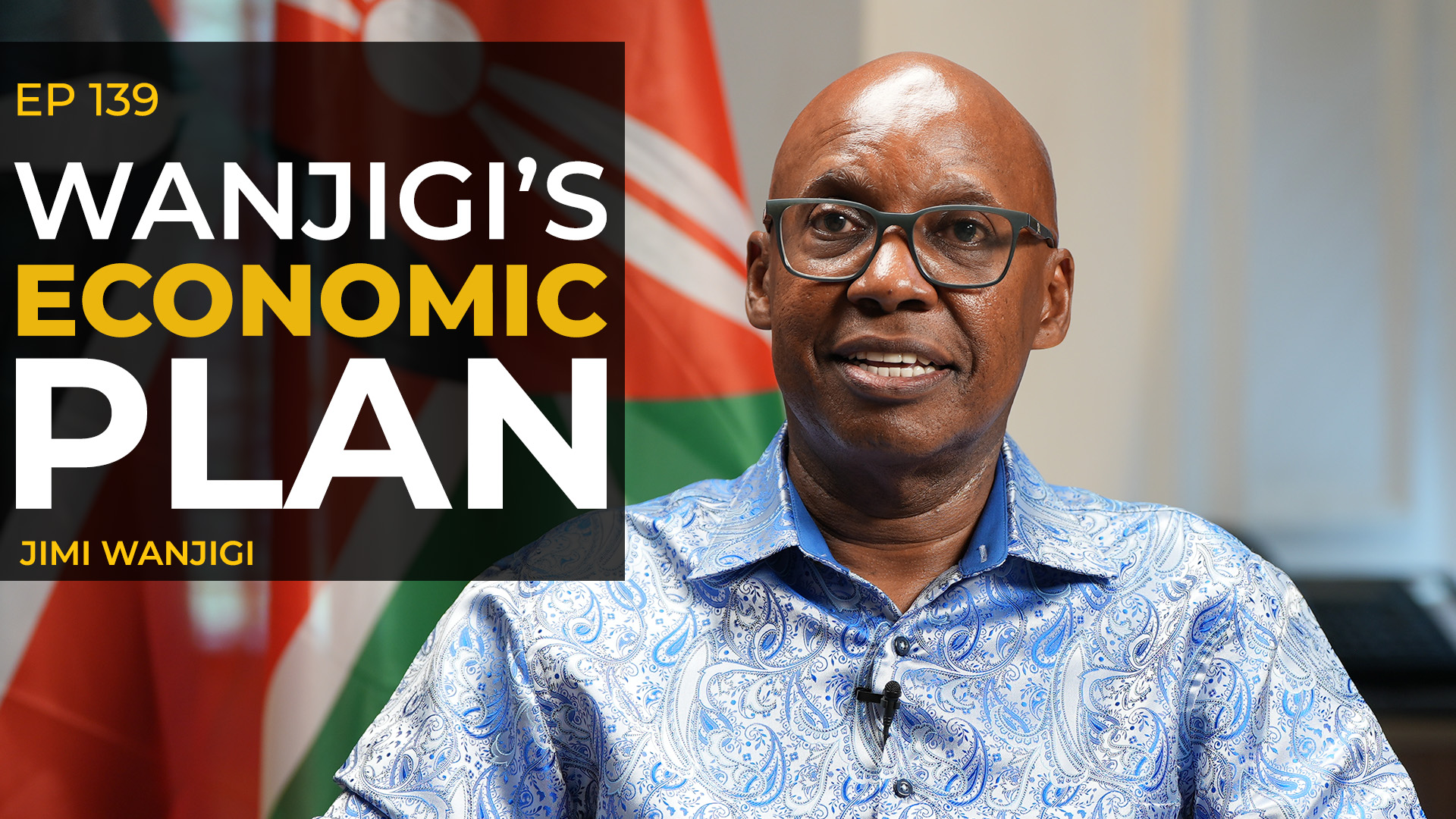

Safina Party leader Jimi Wanjigi has described Kenya as a country in “economic ICU,” warning that the nation’s debt burden, budget structure, taxation model and government borrowing are pushing citizens deeper into poverty.
Speaking on Mambo Africa from his private office, Wanjigi argued that Kenya is not facing an ordinary political crisis but a serious economic emergency. He said the next election should not be reduced to personalities, slogans or tribal politics, but should be treated as a national decision on the future of Kenya’s economy.
According to him, President William Ruto’s biggest opponent ahead of 2027 is not just the opposition — it is the economy.
Watch the full episode here: https://youtu.be/19fYsI4tef4
Gen Z Voter Registration and the Demand for Change
Wanjigi opened the conversation by praising the growing number of young Kenyans registering as voters.
He said the impressive voter registration numbers show that young people are beginning to understand that politics is not something separate from their daily lives. In his view, the youth now recognize that political decisions directly affect jobs, education, healthcare, taxation, cost of living and their economic future.
Wanjigi argued that if Kenya reaches close to 30 million registered voters, the country will have a stronger democratic foundation for deciding its future direction.
For him, the rising youth participation is not just a political statistic — it is a sign that Kenyans are ready to take control of their destiny.
“Budget Conmanship”: Wanjigi Questions Kenya’s Budget Process
A major focus of the interview was Kenya’s budget process.
Wanjigi accused the government of misleading Kenyans by focusing public debate on the Finance Bill while hiding the real budget conversation. He argued that the Finance Bill is only about revenue-raising measures, while the real budget is about where government intends to spend public money.
He said the law requires government to publish expected revenue, expenditure estimates and any anticipated deficit by April 30 every year. According to him, failing to properly publish and debate expenditure before discussing revenue measures amounts to misleading the public.
For Wanjigi, the key question is simple:
Before asking Kenyans to pay more taxes, where exactly is the government spending the money?
Kenya’s Debt Burden and the 2026/2027 Budget
Wanjigi broke down the projected budget figures and argued that Kenya has very little room left for real development.
He said a large portion of the national budget is being swallowed by debt repayment, salaries, government operations and county allocations — leaving only a small amount for development.
According to his breakdown, if Kenya’s budget is around KSh 4.8 trillion, and about KSh 2.6 trillion goes to debt repayment, the country is left with limited money to fund public services and development projects. He argued that this explains why many government promises are not being fulfilled.
His conclusion was blunt: Kenya cannot develop if nearly all tax revenue goes toward debt.
“Kenya Is Bankrupt”: Why Wanjigi Says the Country Is in Trouble
Wanjigi compared Kenya’s current situation to countries that have faced severe economic crises, including Sri Lanka, Lebanon, Greece, Argentina and others.
He described Kenya’s condition as a state of economic bankruptcy, saying the government is surviving largely on borrowed money. He argued that if tax revenue is going toward debt repayment and the government is borrowing domestically to pay salaries and operations, then the economy is in serious danger.
In his view, Kenya is not just experiencing temporary hardship — it is facing a structural economic crisis.
The Safina Plan: Stop Paying Illegal Debt
Wanjigi’s central proposal is for Kenya to audit its debt and stop paying what he calls illegal or odious debt.
He argued that any debt not approved by Parliament, not properly recorded under Kenyan law, or not used for development should not be treated as a legitimate obligation of the Kenyan people.
He said Safina would suspend questionable debt payments, carry out a forensic audit, and identify which debts are legally binding and which are not.
According to Wanjigi, Kenya must stop using citizens’ taxes to pay debts that did not benefit the public.
Redirect Debt Money to Healthcare and Education
Wanjigi argued that if Kenya suspends questionable debt payments, billions or even trillions of shillings could be redirected into essential public services.
He said his plan would prioritize:
- Universal healthcare
- Free primary, secondary and TVET education
- Lower taxation
- Lower interest rates
- Private sector growth
He claimed universal healthcare can be funded if money currently going to questionable debt repayment is redirected to citizens.
He also said primary, secondary and TVET education should be fully funded so that parents no longer struggle with school fees, bursary queues and capitation gaps.
Reducing VAT to a 5% Sales Tax
Another major proposal from Wanjigi is replacing the current VAT rate with a 5% sales tax.
He argued that VAT is one of the biggest contributors to the cost of living because it affects goods and services across the economy.
By reducing VAT from 16% to a 5% sales tax, Wanjigi said Kenyans would keep more money in their pockets. That money, he argued, would stimulate consumption, support businesses and expand the tax base over time.
His argument is that government should not overtax citizens into poverty, but should create conditions where people can spend, invest and grow businesses.
Domestic Borrowing and Why Businesses Lack Capital
Wanjigi also criticized government borrowing from the domestic market.
He said when government borrows heavily from local banks, it crowds out ordinary citizens, small businesses, farmers, creatives and innovators who need loans.
According to him, this keeps interest rates high and blocks private sector growth.
His proposal is for government to stop excessive domestic borrowing so banks can lend to Kenyans at lower interest rates. He argued that if interest rates fall, young people and entrepreneurs will have access to affordable capital to build businesses, invest in agriculture, create content, develop technology and expand industries.
Agriculture: Coffee, Macadamia, Avocado and Value Addition
Wanjigi identified agriculture as one of Kenya’s greatest economic opportunities.
He praised reforms in the coffee sector but argued that more must be done to break cartels, improve pricing for farmers and support value addition.
He highlighted opportunities in:
- Coffee farming
- Avocado exports
- Macadamia processing
- Storage and warehousing
- Fast-freezing technology
- Value addition for export markets
He said Kenya has the potential to create real wealth from agriculture if farmers can access capital, processing technology and fair markets.
Energy Crisis: Why Kenya Cannot Industrialize Without Power
The Safina leader also warned that Kenya’s energy sector is a major barrier to industrialization.
He said Kenya’s installed and transmitted power capacity is too low for the country to achieve serious manufacturing or digital growth.
He cited the example of artificial intelligence and data center investment, arguing that such industries require reliable and abundant power.
Wanjigi said Kenya must focus on expanding renewable energy and attracting private sector investment in power generation. He argued that the country should allow more competition in electricity generation and distribution so consumers can eventually choose providers and access cheaper power.
Creative Economy and Young Innovators
Wanjigi also spoke directly to the creative economy, saying Kenya has immense talent in content creation, acting, digital media and online platforms.
However, he argued that creatives lack access to affordable capital.
He said if government stops crowding out the private sector and interest rates fall, content creators could access funding to build studios, production companies, digital platforms and creative businesses.
For him, Kenya’s young people do not lack ideas — they lack affordable capital and a supportive economic environment.
Foreign Policy and Africa’s Identity
The interview also touched on Kenya’s foreign policy and Africa’s place in the world.
Wanjigi criticized what he sees as weak diplomatic positioning by the current administration, arguing that Kenya must assert itself as part of a proud African civilization rather than constantly seeking validation from Western powers.
He said Africa must recognize its wealth, population, resources and future global importance.
For him, Kenya should play a stronger role in shaping Africa’s economic and political destiny, not simply follow external powers.
A Message to Gen Z: Protect Your Future
Wanjigi ended with a direct message to young Kenyans.
He praised Gen Z for their political awakening and urged them not to be divided by tribe, class, gender or region. He said young people must remain focused on the economic future that is being taken away from them.
According to him, the 2027 election is an opportunity for young people to take control of their future through the ballot.
His message was clear:
Do not allow your economic future to be stolen. Register, vote and demand leadership that works for the people.
Conclusion: Kenya’s 2027 Election Must Be About the Economy
This conversation with Jimi Wanjigi presents a direct challenge to Kenya’s political class.
He argues that the country must move away from slogans, tribal mobilization and personality politics, and focus instead on the real issues affecting every Kenyan household: debt, taxes, healthcare, education, capital, jobs, agriculture, energy and national productivity.
Whether one agrees with his solutions or not, Wanjigi’s argument is clear:
Kenya’s next political decision must be an economic decision.
As 2027 approaches, the question for voters is no longer just who should lead the country.
The deeper question is:
Who has a real plan to rescue Kenya’s economy?
Watch the full episode here: https://youtu.be/19fYsI4tef4

Leave a Reply